






1. Prawn Facts
2. Types of Australian Prawns
3. Prawn Nutritional Value
4. Prawn Health Benefits
Prawns are crustaceans with a firm, slightly chewy texture and a sweet, mild, and distinctly briny flavour, often compared to lobster or crab. They are generally succulent and moist, with smaller, tender, and sweeter varieties like banana prawns, contrasted by larger, firmer, and more intense options such as king or tiger prawns.
History and Origin
Prawns (and their smaller counterparts, shrimp) are among the most ancient crustaceans, with fossils dating back over 180 million years to the Jurassic period. They have been part of human diets for millennia, but their transformation into a mass-market, globally traded commodity is a recent phenomenon driven by the rapid rise of industrial aquaculture in the 1970s and 80s.
- • Tiger Prawns
- • Banana Prawns
- • Endeavour Prawns
- • School Prawns
Australian prawns are world-renowned, with key varieties including King, Tiger, Banana, and Endeavour, each offering distinct tastes from sweet to robust. King prawns offer a rich, sweet, and clean flavour, while Tiger prawns have a firmer texture with a bold, slightly salty, and meaty taste. Banana prawns are milder and sweet, perfect for Asian-style dishes, whereas Endeavour prawns are smaller but often praised for their unique, strong sweetness.
Key Australian Prawn Varieties & Taste Profiles
- Tiger Prawns: Recognized by their stunning dark stripes, which turn bright red when cooked. They have a firm, meaty texture and a consistent, bold flavour, making them ideal for barbecuing.
- Banana Prawns: These are lighter in colour and have a delicate, sweet, and mild taste. They are excellent for hot dishes, curries, or stir-fries due to their firm texture.
- Endeavour Prawns: Often cited as the "best tasting" for their unique sweetness. They are smaller than Kings and Tigers, with a nice firm texture.
- School Prawns: Small, sweet, and very popular in Australia for deep-frying or as a "beer snack".
Best Ways to Enjoy
- Whole/Cold: Tiger and King prawns are ideal for large, impressive platters.
- BBQ/Grill: Tiger and Western King prawns hold up well to heat.
- Stir-fry/Curry: Banana prawns are excellent in hot dishes.
Prawn ( Nutritional value )
Value per 100 g
Crustaceans, shrimp, mixed species, cooked, moist heat (may have been previously frozen)
|
Nutrient ( Proximate’s )
|
Unit
|
Value
|
Daily Value %
|
|
Energy
|
kcal
|
119
|
%
|
|
Protein
|
g
|
22.78
|
45.5%
|
|
Total lipid (fat)
|
g
|
1.70
|
%
|
|
Carbohydrate, by difference
|
g
|
1.52
|
%
|
|
Fiber, total dietary
|
g
|
0.0
|
0.0
|
|
Sugars, total
|
g
|
0.00
|
0.00
|
|
Minerals
|
|||
|
Calcium, Ca
|
mg
|
91
|
%
|
|
Iron, Fe
|
mg
|
0.32
|
1.7%
|
|
Magnesium, Mg
|
mg
|
37
|
%
|
|
Phosphorus, P
|
mg
|
306
|
%
|
|
Potassium, K
|
mg
|
170
|
%
|
|
Sodium, Na
|
mg
|
947
|
%
|
|
Zinc, Zn
|
mg
|
1.63
|
%
|
|
Copper, Cu
|
mg
|
0.258
|
%
|
|
Manganese, Mn
|
mg
|
0.049
|
%
|
|
Selenium, Se
|
mcg
|
49.5
|
%
|
|
Vitamins
|
|||
|
Vitamin C, total ascorbic acid
|
mg
|
0.0
|
0.0
|
|
Thiamin (B-1)
|
mg
|
0.032
|
%
|
|
Riboflavin (B-2)
|
mg
|
0.024
|
%
|
|
Niacin (B-3)
|
mg
|
2.678
|
%
|
|
Pantothenic acid (B-5)
|
mg
|
0.519
|
%
|
|
Vitamin (B-6)
|
mg
|
0.242
|
%
|
|
Folate (B-9)
|
mcg
|
24
|
6%
|
|
Vitamin (B-12)
|
mcg
|
1.66
|
%
|
|
Vitamin A, IU
|
mcg
|
301
|
%
|
|
Vitamin E (alpha-tocopherol)
|
mg
|
2.20
|
%
|
|
Vitamin D
|
mcg
|
4
|
%
|
|
Vitamin D (D2 + D3)
|
mcg
|
0.1
|
|
|
Vitamin D3 (cholecalciferol)
|
mcg
|
0.1
|
|
|
Vitamin K (phylloquinone)
|
mcg
|
0.4
|
%
|
|
Lipids
|
|||
|
Saturated Fatty Acids
|
g
|
0.521
|
2.6%
|
|
Monounsaturated Fatty Acids
|
g
|
0.361
|
|
|
Polyunsaturated Fatty Acids
|
g
|
0.590
|
|
|
Trans Fatty Acids
|
g
|
0.035
|
|
|
Cholesterol
|
mg
|
211
|
%
|

|
Reference Values are based on a 2,000 Calorie Intake, for Adults and Children 4 or More Years of Age. Your daily values may be higher or lower depending on your calorie needs.
|
|
Percentages are roughly approximated using (RDA) Recommended Dietary Allowances for adults. Source: USDA United States Department of Agriculture
|
|
Reference Values for Nutrition – National Institutes of Health USA
|
Prawns Nutritional Value
Prawns are a highly nutritious, low-calorie, and protein-packed seafood (approx. 25g protein/100g) that support heart health, muscle growth, and weight loss. Rich in omega-3 fatty acids, selenium, and astaxanthin, they help reduce inflammation, boost immunity, and strengthen bones. They are also an excellent source of vitamin B12, iron, and choline for cognitive function.
Considerations
Allergies: Crustaceans like prawns are a common allergen.
Sodium: They contain moderate to high levels of sodium, which may be a concern for those on a low-salt diet.
Source: It is recommended to choose high-quality, sustainable sources to avoid environmental contaminants.
PROMOTE HEART HEALTH
Prawns provide a rich source of omega-3 fatty acids, which lower triglycerides, reduce inflammation, and help regulate blood pressure. Despite containing dietary cholesterol, they are very low in saturated fat and high in astaxanthin (an antioxidant), making them a heart-friendly, lean protein source that can improve HDL (good) cholesterol.BOOST THE IMMUNE SYSTEM
Prawns boost the immune system through a high concentration of nutrients, notably selenium, zinc, and Vitamin E, which reduce oxidative stress and combat inflammation. They also contain astaxanthin, a powerful antioxidant, and Omega-3 fatty acids that support immune cell function and help defend against infections.BOOST BRAIN FUNCTION
Prawns boost brain function through high levels of Omega-3 fatty acids (DHA/EPA), vitamin B12, choline, and selenium, which enhance memory, cognition, and nerve health. These nutrients protect against age-related cognitive decline, improve mood, and support neurotransmitter production. Their antioxidant astaxanthin also shields brain cells.IDEAL FOR WEIGHT MANAGEMENT
Prawns are an excellent, low-calorie, and high-protein food ideal for weight management, providing roughly 25g of protein and only 115 calories per 100g serving. Their high protein content increases satiety, reducing overall calorie intake. Additionally, prawns are packed with iodine and zinc, which boost metabolism and regulate fat storage, facilitating weight loss.
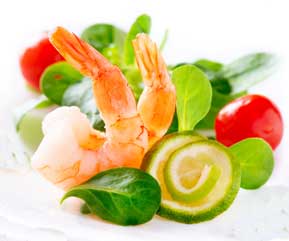
RICH IN OMEGA-3 FATTY ACIDS
Prawns are a nutrient-dense, low-calorie, and high-protein food packed with omega-3 fatty acids (EPA and DHA), which support heart health, reduce inflammation, and improve brain function. They provide essential vitamins and minerals like iodine, selenium, zinc, and Vitamin B12, aiding in thyroid function, immunity, and energy metabolism.SUPPORT MUSCLE GROWTH
Prawns are an excellent, low-calorie, high-protein food for muscle growth, offering 20–25g of protein per 100g serving. They provide a complete protein source containing all nine essential amino acids necessary for muscle repair and hypertrophy. Their high leucine content and selenium content support optimal protein synthesis, muscle maintenance, and bone health.A SUPERFOOD FOR METABOLISM
Prawns are considered a "superfood" for metabolism due to their unique combination of high-quality protein, essential minerals like iodine and zinc, and low-calorie, low-fat content. They directly support metabolic health by promoting satiety, providing necessary nutrients for thyroid function, and helping to regulate fat storage.STRENGTHEN BONES
Prawns strengthen bones due to their rich content of essential minerals, including calcium, phosphorus, magnesium, and copper, which are critical for bone density and skeletal health. Regularly consuming prawns supports, repairs, and maintains bone structure, reducing the risk of osteoporosis and promoting better mobility, particularly as they age.
References
Nutrient Database – USDA (United States Department of Agriculture)
Reference Values for Nutrition – National Institutes of Health USA
Ideal for weight management - Prawns are an excellent, low-calorie, and high-protein food ideal for weight management, providing roughly 25g of protein and only 115 calories per 100g serving. Their high protein content increases satiety, reducing overall calorie intake. Additionally, prawns are packed with iodine and zinc, which boost metabolism and regulate fat storage, facilitating weight loss.
Support muscle growth - Prawns are an excellent, low-calorie, high-protein food for muscle growth, offering 20–25g of protein per 100g serving. They provide a complete protein source containing all nine essential amino acids necessary for muscle repair and hypertrophy. Their high leucine content and selenium content support optimal protein synthesis, muscle maintenance, and bone health.
Promote heart health - Prawns promote heart health by providing a rich source of omega-3 fatty acids, which lower triglycerides, reduce inflammation, and help regulate blood pressure. Despite containing dietary cholesterol, they are very low in saturated fat and high in astaxanthin (an antioxidant), making them a heart-friendly, lean protein source that can improve HDL (good) cholesterol.
Boost the immune system - Prawns boost the immune system through a high concentration of nutrients, notably selenium, zinc, and Vitamin E, which reduce oxidative stress and combat inflammation. They also contain astaxanthin, a powerful antioxidant, and Omega-3 fatty acids that support immune cell function and help defend against infections.
A superfood for metabolism - Prawns (and shrimp) are considered a "superfood" for metabolism due to their unique combination of high-quality protein, essential minerals like iodine and zinc, and low-calorie, low-fat content. They directly support metabolic health by promoting satiety, providing necessary nutrients for thyroid function, and helping to regulate fat storage.
Boost brain function - Prawns boost brain function through high levels of Omega-3 fatty acids (DHA/EPA), vitamin B12, choline, and selenium, which enhance memory, cognition, and nerve health. These nutrients protect against age-related cognitive decline, improve mood, and support neurotransmitter production. Their antioxidant astaxanthin also shields brain cells.
Rich in omega-3 fatty acids - Prawns are a nutrient-dense, low-calorie, and high-protein food packed with omega-3 fatty acids (EPA and DHA), which support heart health, reduce inflammation, and improve brain function. They provide essential vitamins and minerals like iodine, selenium, zinc, and Vitamin B12, aiding in thyroid function, immunity, and energy metabolism.
Strengthen bones - Prawns strengthen bones due to their rich content of essential minerals, including calcium, phosphorus, magnesium, and copper, which are critical for bone density and skeletal health. Regularly consuming prawns supports, repairs, and maintains bone structure, reducing the risk of osteoporosis and promoting better mobility, particularly as they age.